
Dr Halyna Alekseievska is one of two people (alongside dr Vadym Chepizhenko) to have been awarded KRASP and Elsevier scholarships to carry out research projects at the University of Gdańsk in 2026. She is currently working on a research project in the field of sustainable water transport transformation.
The fellowship programme organised by the Conference of Rectors of Academic Schools in Poland (KRASP) in collaboration with Elsevier aims to strengthen the research potential of PhD students and young researchers from Ukrainian universities. Two researchers from the Odessa I. I. Mechnikov National University chose the University of Gdańsk as their placement destination. We spoke to them about the challenges and objectives of their research projects, as well as their impressions of their time at our university.
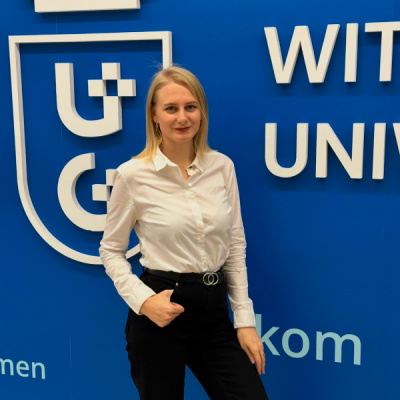
Dr Halyna Alekseievska works in the Department of World Economy and International Economic Relations at Odessa I. I. Mechnikov National University. Her research interests include issues such as global economic transformations (particularly in the area of European integration), transport infrastructure development, the digitalisation of the economy and institutional reforms. She is currently engaged in research into maritime transport as a strategic element of the European logistics system.
As part of the scholarship, she is undertaking an internship at the Faculty of Economics under the supervision of dr hab. Ernest Czermański, prof. UG, working on the project ‘European Experience of Sustainable Transformation of Water Transport and Lessons for Ukraine’. The main objective of the project is to examine European experiences regarding sustainable transformation in the field of water transport and to identify opportunities for applying these experiences to modernise Ukraine’s maritime system.
Interview with Halyna Alekseievska
Karolina Żuk-Wieczorkiewicz: - How did you get interested in water transport and sustainable transformation?
Dr Halyna Alekseievska: - My interest in this topic is a natural evolution of my academic career, rooted in my background. I was born and raised in the Odesa region, so the sea, logistics, and port infrastructure have always been an integral part of life in my region.
My academic journey began at Odesa I.I. Mechnikov National University, where I defended my PhD thesis on monetary policy. After defending my degree, my professional circle expanded, and I began collaborating with fellow scientists specializing in logistics and maritime transport. We prepared a joint scientific publication, and it was then that I saw the immense potential in this interdisciplinary niche.
I realized that macroeconomic processes and the sustainable transformation of water transport are inextricably linked. Currently, I aim to use my experience in economic analysis to explore how the concepts of the 'Blue Economy' and 'Sea Power' can be practically adapted to Ukrainian realities. Gdańsk and its university provide the perfect foundation to see how these theoretical models work in practice.
- How much of your research plan did you manage to carry out so far?
- At the moment, I have successfully completed the preparatory phase and moved into the active analysis stage. Together with my supervisor, Professor Ernest Czermański, we have refined and deepened the original research plan, adapting it to current challenges.
I have managed to systematize the theoretical framework regarding 'Sea Power' and 'Blue Economy' concepts, as well as collect the necessary set of statistical data on the operation of the port sector. I am currently in the process of synthesizing this data to move toward analisis. Professor Czermański guides my work, helping me focus on the most promising aspects of the research.
- What do you like most about the University of Gdansk?
- What I appreciate most at the University of Gdańsk is the atmosphere of openness and support. From the very first day, I felt the professionalism and hospitality of the Welcome Centre - they are always ready to help with any organizational questions, which is crucial for a researcher in a foreign country.
I am also impressed by the scientific infrastructure. The University Library provides excellent working conditions: the quiet environment and access to the latest international publications and digital databases create an ideal setting for a deep dive into the topic. And, of course, the interaction within the academic community is invaluable. There is genuine interest in my research here, and the professor's support inspires me to move forward.
- What are greater challenges during your scholarship?
- The main challenges of my research are academic and interdisciplinary in nature. First and foremost, it is the data collection: under current conditions, statistics regarding Ukrainian ports are very dynamic, making it difficult to gather stable indicators for comparative analysis. The topic also requires combining knowledge from various fields - from economics to maritime law. However, thanks to the university's support and access to resources, I cannot say that I encounter any major difficulties during my internship.
- In your research here, was there something that especially impressed you or surprised you?
- I was impressed by the EU’s comprehensive approach to implementing the 'Blue Economy' strategy. It is remarkable to see how closely economic interests, environmental standards, and security issues are intertwined here.
It was also interesting to discover how detailed the mechanisms of interaction between ports, the state, and international logistics networks are in Poland. For me, as an economist, this is a clear example of how theoretical concepts are translated into specific tools for infrastructure management and development.
- What are your greater hopes and goals connected with your stay at the University of Gdansk?
- My main goal is to build a high-quality scientific and theoretical foundation for future publications and practical recommendations. I hope that the results of my research will help better understand how to adapt European 'Blue Economy' strategies to the specific needs of Ukrainian ports.
Furthermore, strengthening academic ties between our universities is very important to me. I believe that this experience will serve as a basis for further joint cooperation with Polish colleagues in the field of maritime transport studies.
- Would you recommend our University to other researchers and PhD students? Why?
- Yes, I would definitely recommend the University of Gdańsk to my colleagues.
The university provides good conditions for those involved in maritime topics, as it is located in a major port hub, offering the opportunity to study the industry in practice. For PhD students, it is valuable experience to work in a European academic environment and receive expert consultations from professors specializing in transport economics.
Finally, I would like to express my sincere personal gratitude to my host professor, Dr. Hab. Ernest Czermański. I am very grateful to him for agreeing to supervise my research and for the invaluable guidance he provides. I also want to thank Magdalena Dziki for her great support with all the organizational matters. It is thanks to these people that my stay here is so productive and comfortable.
Interview with Vadym Chepizhenko: KRASP and Elsevier scholarship holders at the University of Gdańsk. An interview with Vadym Chepizhenko