
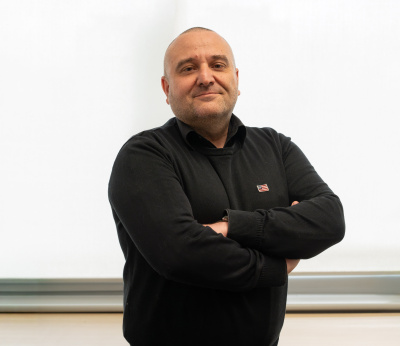
Dr Rafał Lasota from the Faculty of Oceanography and Geography at the University of Gdańsk is carrying out the project ‘Restoring Oceans and Waters in European Regions’ as part of the ‘Horizon Europe’ programme.
The project, with the acronym ROWER (Restoring Oceans and Waters in European Regions), is being carried out as part of an international consortium. The leader is the University of Tartu (Tartu Ülikool, Estonia), and the consortium includes research and administrative institutions as well as environmental organisations from many countries in Europe and beyond, including Estonia, the Netherlands, Spain, Lithuania, Poland, the United Kingdom, Norway, Portugal, Italy, Greece, Romania, Turkey, New Zealand, and Tunisia. In total, 15 research institutions are involved in the project, collaborating with 18 administrative and management institutions, with the participation of over 200 stakeholders.
On the University of Gdańsk side, the project is carried out by a team from the Faculty of Oceanography and Geography: dr Rafał Lasota, responsible for coordinating the project at the university, as well as dr Iwona Pawliczka vel Pawlik and prof. Adam Sokołowski, serving as the project’s principal investigators. On the Polish side, the Słowiński National Park is also involved in the project as an associate partner. It is within the Park’s territory that innovative renaturation tools will be tested.
‘Biodiversity loss and ecosystem degradation threaten the functioning of ecosystem services - the foundation for delivering social goods and benefits within the global blue economy and a key element of human well-being. Ongoing environmental changes require decisive systemic actions, encompassing both nature conservation and the restoration of degraded areas. The European Union has adopted the goal of restoring, protecting, and maintaining the good condition of aquatic ecosystems - both marine and inland. By 2030, at least 30% of the EU’s marine areas are to be covered by effective protection within an ecologically coherent network of protected areas,’ reports dr Rafał Lasota. ‘The project addresses these challenges by providing interdisciplinary knowledge in the fields of natural and socio-economic sciences, as well as practical tools to support the implementation of environmental policy. Activities will be carried out in 13 research areas serving as case studies (Case Study Areas), located along the European coasts of the Atlantic Ocean, the Baltic Sea, the North Sea, the Danube and the Black Sea, and the Mediterranean Sea. Pilot renaturation activities will cover areas with a total surface area of over 5,000 km².’
Research and pilot activities
The project is interdisciplinary in nature and combines scientific research with activities that have implementation potential. It includes both the analysis and synthesis of the current state of knowledge, as well as:
- field research conducted in areas subject to restoration activities,
- experiments and testing of practical restoration solutions,
- simulations using Digital Twin technology, enabling the analysis of various action scenarios in ecosystem models,
- collaboration with public administration, protected area managers, and a wide range of stakeholders.
Significance and use of results
The results developed in the project will support decision-making processes in the field of environmental protection as well as the planning and implementation of renaturation activities. The project includes, among other things:
- developing scaling scenarios for the tested solutions,
- making available over 50 datasets and services compliant with FAIR principles (Findable, Accessible, Interoperable, Reusable),
- supporting institutions responsible for implementing nature conservation policies and operational activities at the local, regional, and national levels.
The project received funding in the amount of 12,543,240 euros, of which 384,687 euros were allocated to the University of Gdańsk.
Biogram
Dr Rafał Lasota graduated with a degree in oceanography from the University of Gdańsk, where he subsequently earned his Ph.D. in Earth Sciences with a focus on oceanology. He is affiliated with the Faculty of Oceanography and Geography at the University of Gdańsk, where he serves as an assistant professor in the Department of Marine Ecosystem Functioning. His research focuses primarily on the ecology and genetics of marine invertebrates. He has been awarded scholarships from UNESCO and the French government. His body of work includes over 20 scientific publications, mainly in international specialized journals, as well as chapters in monographs and numerous presentations of research results at conferences. He has participated in over 20 national and international research projects, funded, among others, by the European Union and bilateral cooperation programs, serving as a research team member or project leader.
About all program laureates: read here.