
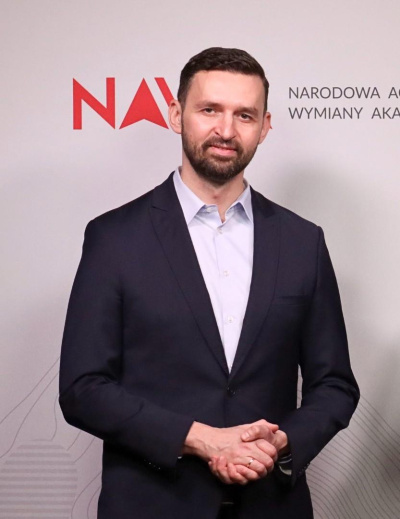
Work is underway on the National Strategy for the Internationalisation of Polish Higher Education and Science - a practical tool supporting the internationalisation of Polish universities and research institutes, thereby strengthening Poland’s position in the global science system. Why does internationalisation play such a crucial role in improving the quality of research and scientific development in Poland? What needs should it address? We discuss this with the director of the National Agency for Academic Exchange (NAWA), dr Wojciech Karczewski.
Urszula Abucewicz: - The National Agency for Academic Exchange (NAWA), in cooperation with the academic community, has developed the National Strategy for the Internationalisation of Polish Higher Education and Science through 2035. What are the strategic goals of this document?
Dr Wojciech Karczewski: - The strategy has already been developed and is currently in the final phase of community consultation. A team of experts representing the most important organisations involved in science and higher education in Poland worked on the Strategy for the Internationalisation of Polish Higher Education and Science until 2035. It also incorporates comments and proposals from the Ministry of Science and Higher Education. We are speaking at the University of Gdańsk, so it is worth mentioning that one of the co-authors of this strategy is the Vice Rector for Cooperation and Internationalisation, dr hab. Anna Jurkowska-Zeidler, a professor at the University of Gdańsk, representing CRASP.
The document identifies four main areas of action: the internationalisation of research and the research landscape, the development of the international academic community, the dissemination of international experiences, and the internationalisation of education, including the development of modern forms of education.
Internationalisation makes sense when it primarily addresses the needs of the economy and the labour market. The authors of the strategy assumed that internationalisation should be treated in a systemic and long-term manner - as one of the most important elements of the country’s development. It is not merely an additional area of activity for universities and research institutes, but a process that permeates all their functions and is linked to public policies.
International cooperation and internationalisation in the field of Polish higher education and science should be treated as one of the key elements of the country’s development.
Intellectual capital is one of the main drivers of national development. Without it, it is impossible to compete with the best, and internationalisation involves, among other things, competing for talent from around the world to work for the benefit of the Polish economy.
We are currently facing demographic challenges; the population of our country is declining, and along with this trend, the number of students at Polish universities is decreasing. So, first, this gap must be filled, and second, if we want to expand - or at least maintain - the country’s current development, we need high-quality graduates.
We can fill this demographic gap with people from abroad, which is why one of our priorities is to analyse which countries we need to develop cooperation with and which industries require strengthening to increase the number of students, researchers, and doctoral candidates from abroad. The next step will be to encourage them to stay in Poland, because as people educated in our country, who know our language and the specifics of our nation, they can provide added value to our economy - whether as researchers or by entering the Polish labour market. All of this, of course, must be done thoughtfully and with a concrete plan.
- The strategy mentions strengthening the potential, visibility, and attractiveness of Polish science and higher education institutions worldwide. How will this “visibility” be enhanced? What ideas and proposals are included in the document?
- This is a key aspect of the strategy. Visibility is not, and cannot be, understood solely as a promotional campaign. It should be built primarily through the tangible presence of Polish research and higher education institutions in the international scientific community. What does this mean? It means greater engagement in international research collaboration; it means active participation in international projects and events. It involves consistently building and strengthening the position of our scientists as experts. At the same time, the strategy calls for the development of scientific diplomacy initiatives designed to promote Polish achievements and build long-term international relationships.
We cannot overlook the role of young people from the Polish diaspora studying in Poland and foreign graduates, who can become ambassadors for Poland and naturally enhance the visibility of Polish universities abroad. I have the impression that this remains an underappreciated and underutilised asset, yet the personal stories and successes of individuals, along with their daily experiences, serve as a testament to the high quality of Polish higher education. This showcases Poland as an attractive place to study and live in many respects.
Improving the quality of research and education, developing joint study programs and strategic partnerships, and attracting students and researchers from other countries are also of key importance. It is precisely these elements that are intended to make Polish institutions more visible - as active and credible participants in global science.
- One of the goals outlined in the National Strategy for the Internationalisation of Polish Higher Education and Science is to promote international experience among all members of the academic community. What does this statement entail? How can this goal be achieved?
- International experience should not be reserved solely for a select group of students or researchers. According to the strategy, it should become a natural part of the functioning of the entire academic community - students, doctoral candidates, and academic and administrative staff. It is broadly understood as any educational, research, or development activity that allows for the acquisition of international and intercultural competencies.
Achieving this goal relies primarily on developing various forms of mobility - not only study abroad programs but also virtual and hybrid mobility - and on the concept of so-called ‘internationalisation at home’. Thanks to this, international experience can also be gained locally, without the need to travel abroad.
In practice, this means, among other things, the development of international study programs and joint degree programs, the integration of a global perspective into curricula, and the implementation of courses and projects in collaboration with international partners.
Equally important is building an environment that fosters internationalisation - through the development of language skills, organisational support for outgoing and incoming students, and the creation of an open, multicultural academic space. This also includes more practical solutions, such as multilingual communication on campus or adapting infrastructure to the needs of international students.
As a result, international experience ceases to be an exception and becomes a standard part of studying and working at the university.
- Will the implementation of these measures rely on existing tools - such as the development of Erasmus+, Horizon Europe, and the increased role of micro-credentials and mutual recognition of learning outcomes - or are there plans to develop new tools and standards?
- When it comes to tools, we have a great many of them. From EU programs such as Erasmus+ and Horizon Europe to nearly 30 programs of the National Agency for Academic Exchange, which support international cooperation at the institutional, academic, and student levels. The range of opportunities is truly extensive, and what’s encouraging is that Polish universities are eager to take advantage of them. The Ministry of Science and Higher Education is responding to this growing interest by increasing NAWA’s budget every year, which is then distributed to Polish universities and research institutes in the form of grants for specific international projects.
Regarding funds from EU programs, the problem is that Poland still makes limited use of them; unfortunately, we lag behind the rest of Europe when it comes to effectively securing them.
- What is the reason for this?
- There are many reasons. One of them is administrative issues. In many countries, the process of securing EU funds is often professionalised. At many universities and research institutions - not only in Western Europe but also in our part of Europe - there are specialised teams dedicated exclusively to preparing grant applications. These teams employ experienced specialists who know how such applications should be written, and this translates into high success rates.
In Poland, things are getting much better year by year, but unfortunately, applying for a grant, scholarship, or funding is often an additional burden for researchers who want to secure these funds. As a result, there is a lack of time, and sometimes experience, to ensure that applications are written to the required standard.
Another issue is international experience. Although the situation in Poland is improving, there is still much to be done in this area.
It can be observed that researchers who already have extensive international experience are more successful in securing grants, whether they gained it by working for a time at foreign universities or through programs such as Bekker NAWA, under which we fund stays of up to two years at the world’s top academic centres. The latest round of the program has recently been concluded, with 119 researchers receiving support. Through the Bekker program, nearly a thousand people have already received such scholarships from us, enabling them to stay at the world’s top centres. Upon returning, researchers are better positioned to apply for prestigious grants. Collaborating with the best or simply observing how the best operate often changes the way one thinks and functions within the scientific community. This is another advantage of mobility and international cooperation.
- You mentioned that one of the goals of the National Internationalisation Strategy is the development of innovative digital forms of education and mobility. In this context, what are your thoughts on work in AI and the use of artificial intelligence in science?
- Artificial intelligence is far from replacing humans in the entire research and educational process. And thankfully so; however, it is a truly very useful tool, without which daily work in many fields of science is already unimaginable.
As for work on artificial intelligence, we should join this global race as quickly and on as large a scale as possible - while AI hasn’t yet pulled so far ahead that we can’t catch up and become a major player, rather than just a consumer of products created abroad. Of course, there are positive examples, but they are few and far between. However, in this case, it is not just a matter of science, but of the entire economy. OpenAI, the company that created ChatGPT, spent an amount comparable to the entire annual budget for Polish science and higher education just to get the company off the ground. That is why cooperation with the private sector and synergy between scientists and entrepreneurs is crucial.
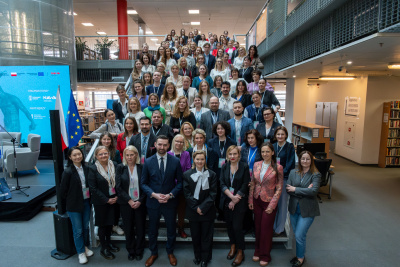
NAWA Director dr Wojciech Karczewski attended the conference 'Cooperation Without Borders - Building the NAWA EURAXESS Regional Network' at the University of Gdańsk; photo: M. Byczkowski
- The University of Gdańsk is the coordinator of the NAWA-Euraxess Network project for the Pomeranian Voivodeship. What are the main objectives of this project?
- EURAXESS is a pan-European initiative that, in practice, serves as a comprehensive support system for researcher mobility - both within Europe and in relations with other regions of the world. Its main goal is to facilitate the movement of researchers, advance their careers, and foster international scientific collaboration. It also provides practical assistance with organisational matters such as legalising residency, obtaining visas, insurance, and help in arranging schooling for children. It also promotes the international mobility of foreign researchers and doctoral students who wish to come and work in Poland. Finally, it involves developing the competencies of administrative staff who deal daily with cooperation with people from abroad, researchers, and doctoral students, and lastly, it involves promoting the region internationally, in this case, the Pomeranian region.
- During the conference ‘Cooperation Without Borders - Building the NAWA EURAXESS Regional Network’, held at the University of Gdańsk, work began on developing a shared vision and future directions for the regional EURAXESS network in the Pomeranian Province. It is to be based on four main objectives: attract, welcome, connect, and integrate. What do you think about the idea of integrating Gdańsk’s universities into the Fahrenheit University Association and creating a strategy for Pomerania?
- The world’s leading universities are often quite large institutions that encompass a wide range of disciplines, which is why any form of integration among regional universities is a very good idea. It makes it easier to compete with the best centres abroad. The issue of scale is one of the reasons why Polish research centres rank so low (around 300-400) in global rankings, even though we have truly strong universities in many fields that are highly regarded by foreign partners. Of course, the Fahrenheit University Consortium is not a single university but a consortium of universities; however, it could be the first step toward such consolidation. As for the strategy for Pomerania itself, international cooperation and internationalisation can serve as tools to support development where there is real potential, and there are truly many such areas in Pomerania.