
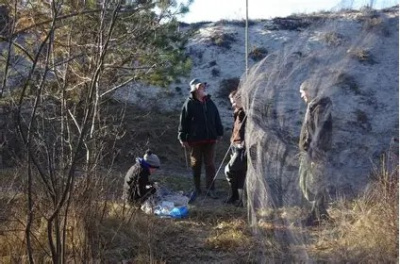
Nearly 90 ornithologists will meet this weekend in Jastarnia to celebrate the 65th anniversary of the Operation Baltic Migratory Bird Research and Monitoring Programme and discuss the future of the project. Operation Baltic is the longest-running citizen science project in Poland and one of the oldest of its kind in the world.
The first observation report was recorded in notebook No. 1 in September 1960. Since then, bird observation, ringing and measuring activities have been carried out twice a year - in spring and autumn. The Operation Baltic team, led by dr. inż. Jarosław K. Nowakowski, an ornithologist from the Faculty of Biology at the University of Gdańsk, also includes: Head of the University of Gdańsk Bird Migration Research Station prof. dr hab. Magdalena Remisiewicz, mgr Katarzyna Rosińska, mgr Krzysztof Stępniewski, mgr Katarzyna Stępniewska, mgr Justyna Szulc, mgr Michał Redlisiak, and mgr Aleksandra Niemc. The honorary chairman of the team is retired prof. dr hab. Przemysław Busse, founder and long-time manager of the Operation Baltic. The work of ornithologists during each campaign is supported by students and volunteers.
The first bird to be ringed in 1960 was a robin. Since then, almost 2 million birds have been ringed. Most of them have been carefully measured, which is the most valuable resource of the programme. Almost 10,000 return messages have been obtained, i.e. information about birds ringed at Operation Baltic field stations and later captured elsewhere, or ringed earlier elsewhere and then captured at Operation Baltic stations. Among the captured birds were as many as 15 species that had never been observed in Poland before. The latest sensational discovery by ornithologists is the first Caspian reed warbler Curruca mystacea in Poland, ringed on 29 April 2025.
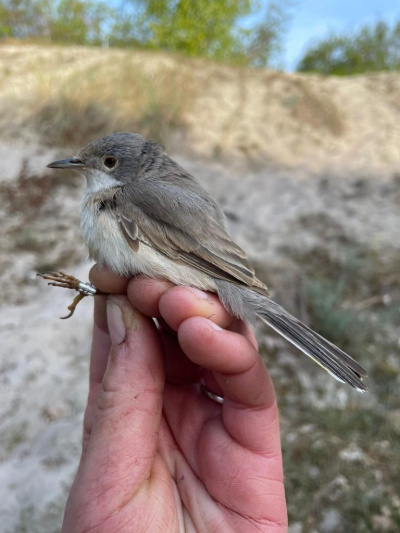
Caspian reed warbler
Operation Baltic is the longest continuously operating network of bird ringing stations in the world.
‘Thanks to the involvement of thousands of volunteers working under the guidance of scientists from the Bird Migration Research Station of the University of Gdańsk, invaluable data has been collected illustrating the changes taking place in the biology and structure of migratory birds. We observe that changes in the environment are affecting the wing structure and body size of some species, and this is evolution caught in the act,’ says dr Jarosław K. Nowakowski.
The number of field days at Operation Baltic stations has exceeded 20,000.
‘Since each station is staffed by 5-10 people, it can be estimated that a total of approximately 140,000 person-days were worked in collecting scientific materials. If this work were done by one full-time employee, they would have to work for 560 years,’ adds the head of Operation Baltic.
The methods developed by the Operation Baltic are used in many countries on four continents - in Europe, Asia, Africa and North America. Scientists working on the project have trained ornithologists in countries such as South Africa, Ethiopia, Egypt, Jordan and Mexico. During work at foreign stations, a huge photographic documentation and thousands of pages of organised notes were collected, which allows evolutionary theories to be tested on a much larger scale than just our Polish backyard.
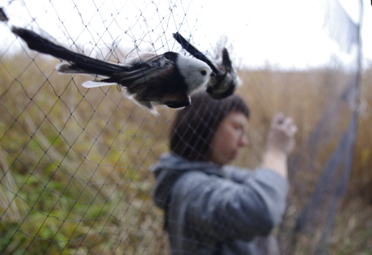
‘Currently, in addition to continuing the data collection that began 65 years ago, modern methods are also being used. We attach geolocators to birds to precisely track their migration routes, conduct genetic analyses, and test acoustic methods of tracking their flight,’ explains dr Jarosław K. Nowakowski.
This weekend in Jastarnia, nearly 90 ornithologists from all over Poland will celebrate the 65th anniversary of the Operation Baltic and discuss the future of the project. Representatives of local governments have also announced their participation in the event.
Operation Baltic website: Operation Baltic
Interview with prof. Przemysław Busse, founder of the Operation Baltic Research Programme, conducted by Włodzimierz Raszkiewicz in 2020 (automatic English subtitles available in settings).
| Attachment | Size |
|---|---|
| Program 65-lecia Akcji Bałtyckiej w Jastarni | 306.88 KB |