
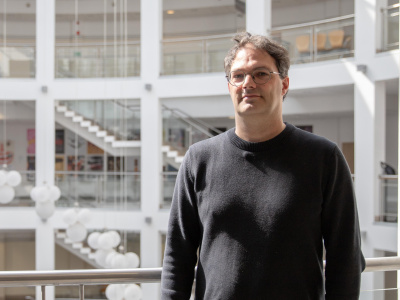
Solidarity in diversity - interview with prof. Stijn Oosterlynck
Can we build solidarity in diverse communities? How to find or create crucial factors that make people feel they have something in common? Can solidarity be influenced by spatial design? What inspirations came from the city of Gdańsk? These and other aspects of solidarity in diversity were the subject of our talk with Stijn Osterlynck, a participant of the ‘UG Visiting Professors’ programme at the University of Gdańsk.
Karolina Żuk-Wieczorkiewicz: - You were invited here in connection with research on solidarity in diversity. This term may sound like a challenge. How can diversity build solidarity?
Stijn Osterlynck: - Solidarity is very important in our societies. In the 20th century, we learned that if we live in a capitalist society, we need solidarity to keep society alive. Labor market doesn't give everybody access to what they need to have a life of dignity, with sufficient resources. In a society which is secularised, which doesn't have religion to hold us all together, in which everybody makes their own individual choices, and where you have a capitalist labour market - in such circumstances, we need solidarity to maintain social bonds and a sufficient level of social protection for people.
We've learned a lot about how to do this in the past 100-150 years. We've devised (in many countries) different systems of social protection and social cohesion. And so, solidarity is something that we know quite a lot about, but the institutions and the structures of solidarity often require a certain level of cultural homogeneity. They require us to be involved in a kind of similar cultural framework. But if we look at our contemporary societies in Europe, we see an increasing amount of ethnic and racialised diversity due to migration and mobility.
- Borders are open…
- Yeah, borders are open, people engage in tourism or move elsewhere to find a job, to improve their lives. In these kinds of circumstances, solidarity cannot only be based on people belonging to a similar cultural community or a nation. We started exploring whether it is possible to have solidarity extending beyond cultural boundaries. We noticed that solidarity is very well developed within national states, but it is somehow believed that to get access to solidarity, people need to belong to the same culture. Nowadays, it is becoming increasingly difficult. Especially in societies where there is a lot of migration, tourism and mobility, we cannot expect the culture to be homogeneous. In this context, I believe we need to find ways to make solidarity in diversity possible.
- If we do not share a cultural framework, is there anything else we can have in common?
- The ground rule is that if you want to be in solidarity (to share resources, space or life), you need to have something in common with other people. Otherwise, you will be different.
- During your research, did you find anything that could be the basis of being ‘in common’?
- We were looking for new forms of solidarity in the context of high levels of ethnic and racial diversity, and we found quite a lot of examples in particular places (such as public spaces, a factory floor, a school). We observed at the microscale how people interacted. We found, for example, that in some places, people felt responsible for the place and its functioning. And because they were sharing the same space, they felt they had something in common, even though they might be very different culturally. Therefore, they were willing to engage in solidarity with each other.
- Can you give an example?
- We found factory floors where people of 70 or 80 different nationalities were working together, and still there was solidarity amongst colleagues. They would help each other; they would care for each other in the context of that factory floor - because they were responsible for the work being carried out. Efficiently, they were responsible for creating an environment in which it was nice to go to work. In these kinds of circumstances, despite being a very diverse group, people were willing to engage in mutual support of each other.
- Do you think these findings can be transferred from the microscale to the macroscale?
- That is the big question. We found a number of different microscales in which we saw these kinds of solidarities. It is not so easy to move that to the macroscale because what people share is proximity, being close to each other in the same place. If you move to a larger scale, it becomes more difficult. For example, we found schools in which people had been building forms of social support at the micro level. But if it came to organising support amongst different schools, from the more privileged schools to the poorer ones, that became much more difficult.
- It seems like a challenge.
- It requires different types of organisation. However, we have been there before. We have the example of Gdańsk: something started off here in the shipyards, where people were sharing the same place, and then it became a bigger movement. The same is true for the welfare state. A lot of the initiatives that would later become national welfare states also have local roots (such as local housing cooperation that would build houses for low-income families). We don't know how exactly our efforts would work in the case of spreading solidarity. But we've also seen how this could happen before.
- What can we do, then?
- Firstly, it's a matter of finding ways of organising, creating something based on local solidarity and adapting it to a wider scale. Secondly, it's about perceptions. If people in Poland (or in Belgium or France) are in solidarity with each other, in fact, they are in solidarity with people they don't know. If there are around 40 million people in Poland, it’s impossible to know all of them personally. So, we have an idea of who these other Polish people are. We imagine them to be a little bit like us, as we live in the same country, share the same history, or watch the same television - but we don't know that for sure.
- They may be more different than some people in Belgium or England.
- Exactly!
- Are people able to change their perceptions?
- Maybe if you let people experience (on the local micro level) what it means to function in a more diverse society, they might change their perception. We may discover that ‘other’ people are not always as different as we think they are, that they have similar concerns about their children or about finding a job. And then perhaps our idea of what it means to be Polish or Belgian, or what it means to live in the same country, will change as well. The change in the community should be based on changing people's perception on a micro level, on local solidarities – and then moving it to a wider scale.
- Do you think migration and this international movement can help in that process, or is it more like a challenge?
- Well, one of the ways in which solidarity on the European level was halted was the Iron Curtain. At that time, a part of Europe belonged to the communist bloc, while another part belonged to the capitalist bloc. Because of that spatial separation, there was very little contact and exchange of information between people, so it was hard to build solidarity on the European level. Now the Iron Curtain has been gone for nearly 40 years. In Western Europe, we are much more aware (even if not sufficiently) of the histories of Eastern European countries, and this is due to migration, because there are many people from Eastern Europe who come to Western Europe to work. When you get into contact with those people and listen to their stories, they become closer.
- They become real people.
- Yes, they become real people and everything that concerns them (such as newspaper reports) becomes more relevant. It's the same about the war in Ukraine, however horrible that war is. People know much more about Ukraine now. The movement makes the exchange of information easier, and people become much more aware of each other. Therefore, the imagination of what it means to be European changes, and I think that it's necessary to start experiencing solidarity and being in favour of it.
- How can solidarity be created in Europe?
- Let’s take European Union investments. We can see a lot of investments in Eastern Europe, even here, in the Pomeranian region. This is a very concrete form of European solidarity. However, we have similar examples across the whole of Europe - and this may create a feeling of belonging to one community. This is the way in which redistribution of resources may result in solidarity.
- According to your research and observations, what are the main obstacles that restrain solidarity?
- When you look at certain places, there is a very strong tendency that people who feel they have been living somewhere longer than others consider themselves the ones who have the right to decide what the place should look like. It's also a way of controlling and maintaining power over a place. However, when new people are moving into the neighbourhood, this power becomes harder to maintain. Those ‘new’ people also want to participate in decisions on what public space should look like. I'm thinking about cities like Antwerp, where more than half of the population has a migration background, or Brussels, where almost 80% of people have a migration background.
So, one of the biggest obstacles is some people’s idea that if they have been living in a place for a longer time, they're the ones who decide, and the rest just need to adapt. That becomes increasingly difficult, though. For example, in the Dutch-speaking region in Belgium, where I live, 25% of the population has a migration background - and that's a lot! As the group gets bigger, it becomes harder to just say ‘you all have to adapt’.
- What challenges does it create?
- If people believe they have more right to decide because ‘they have been there for generations’, it becomes harder to integrate with the newcomers. That kind of hierarchy is an obstacle to recreating society and maintaining solidarity. But I do think that if diversity increases, we must have more inclusive ways of dealing with that. And people just have to say, for example: ‘Okay, Eastern European migrants are coming to Europe, but they contribute to society, so they should have a say as well. They should be seen as citizens.’
Another challenge is that the history of places is often used by an established group to maintain power over that place. It's a political game, in fact. We don't remember what happened in a certain place before our group settled there. If you go back, there are very few places where the population has been staying the same for thousands of years. It's natural to have population movements, but people tend to forget about that.
- Do you think that arranging a place, for example, the city, or maybe just building the surroundings, can somehow help in creating solidarity? Can a place make people feel good enough to feel they have something more in common with others?
- In our research, we had several examples in which places were physically designed in particular ways and that had an effect on solidarity. For example, we found that in certain companies, there is a very strict spatial separation between people doing manual work on the factory floor and the administration doing more intellectual work. We found factories in which there were up to 70 nationalities on the factory floor, but these people would enter the factory through a different entry than administration workers. Because these people never met, solidarity was undermined.
We also did research in a social housing neighbourhood. It showed that people from different housing blocks disliked each other, and if you asked them why, they would not really have good reasons for that. It was just about the fact they were living in different housing blocks; they didn't meet each other a lot; they didn't use the same places. We tried to design a communal space between these blocks, a place where people could meet up: we put a table and chairs there, as well as play tools for children. It took a lot of effort to convince people to go there, but once you succeed in bringing people to the same place, they discovered that they didn’t differ that much from one another.
- So, spatial design really matters?
- Yes. A place which stops us from meeting each other is a wrongly designed place. Urban designers should take such things into account. For example, when there is communal space between the offices, there’s an opportunity for people to meet. It will not always happen, but at least the possibility is there.
- I suppose that working on solidarity demands cooperation between different scientific areas.
- Our work on solidarity is very interdisciplinary. It involves sociologists who have been thinking a lot about solidarity, but who are not very inclined to think about space, and geographers, who are thinking a lot about the value of place and the value of networks. We also involved educationalists who know that learning how to use a place is a process in which people also learn something about each other.
Solidarity is not just there; it's a process of learning about others and about what you share with others. By doing so, we have involved several different disciplines in social sciences to understand solidarity better.
- What can you tell about your visit to Gdańsk? What are your impressions and research plans?
- Before coming here, we've been doing a lot of research projects on solidarity. In one of them, SOLiDi (Solidarity in Diversity, a Marie Curie training network), we trained 15 doctoral students to do research on place-based solidarities. Prof. Maria Mendel was involved in the project as an external advisor. She invited me here because she had plans to develop a Master's program in solidarity research. I think it's a very good idea. There are a lot of academics around Europe who do research on solidarity, but the city of Gdańsk has a very specific history with the term “solidarity”. It is the birthplace of Solidarnosc, the trade union that consciously used the word during their fight against the authoritarian communist state.
My idea is that if there is one place in Europe where you could start understanding different forms that solidarity can take, it should be Gdańsk. Here, you can really immerse people in a very specific history of how people learned to practice solidarity and to struggle for it. So, hopefully, one of the outcomes of my stay here is that the Master program in solidarity studies will be established. I hope it will start attracting students to come to Gdańsk to learn about solidarity not just in the classroom, but also in other ways, such as going to the European Solidarity Centre, which is a place where solidarity is actively kept alive. It’s much more than a museum. There is a library there; people publish about solidarity, think about solidarity; there are NGOs in the building. There are a lot of conferences and events. It's a good place to meet – and it's an infrastructure.
- I suppose infrastructure is a crucial factor.
- I strongly believe that solidarity is something which is practised in particular places. Unfortunately, it disappears when people stop doing certain things. To give it a longer life, you need to have a structure. And Gdańsk has an infrastructure, buildings (such as Shakespeare Theatre), and organizations which maintain that and support the practices of people. I also think that it is very special to this city.
- Gdańsk seems to be a good place for solidarity studies, then.
- It's an excellent place; it's a unique place. It's not just a good place.
- What can Europe learn from Gdańsk?
- What Europe can learn from Gdańsk is the history of citizens creating social movements, creating their own structures to fight for solidarity. I think people in Europe can really learn a lot from coming here and seeing how solidarity has been created and recreated over decades, how it required organization infrastructure and so on. I think everybody can take this message home and say: “Okay we should do similar things as the people of Gdańsk”.
- What would you wish for the students you met during your stay?
- We had an intensive course for one week with an international group of students from Poland, Italy, Spain, Turkey, and Kazakhstan. For four days, we went around the city, we went to the European Solidarity Centre, to the Shakespeare Theatre, to the Art Incubator in Sopot; we also saw the metal sculptures in the area which had been redeveloped around on the former shipyards. What I really hope is that by having immersed in this place, in Gdańsk, all these students will be inspired to give form to solidarity in their places. It doesn't have to be the same as in Gdańsk. But I hope that they learn how solidarity can take new forms depending on context. They had an opportunity to learn from inspiring examples here to do something similar elsewhere in Europe.
- Thank you!