
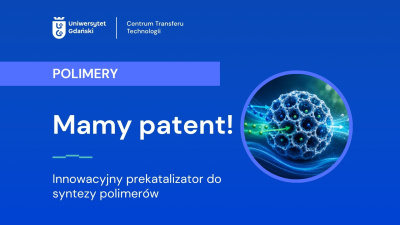
Researchers from the Faculty of Chemistry at the University of Gdańsk have patented a new oxovanadium(IV) coordination compound. The invention may find application as a precatalyst in the synthesis of polymeric materials - ranging from plastics with precisely engineered properties to materials capable of absorbing gases, which in the future may support the development of environmental protection technologies.
The production of polymers, particularly polyolefins, is one of the most important sectors of the modern chemical industry. They are used to make, amongst other things, films, packaging, components for medical devices and parts for the automotive industry.
To create materials with new properties, increasingly advanced catalysts are required, enabling polymers - such as polyethylene - to be produced more quickly and in a more controlled manner.
The patented solution relates to an oxovanadium(IV) coordination compound, intended for use as a precatalyst in the synthesis of polymeric materials. Upon activation, the precatalyst forms an active catalytic system responsible for the course of the reactions leading to the formation of polymers. Importantly, such a system can influence not only the efficiency of the process, but also the structure and properties of the resulting material.
More flexible, capable of absorbing gases
‘Our aim was to develop an oxovanadium(IV) coordination compound that could act as an effective precatalyst in processes leading to the production of polymeric materials. However, we were not only interested in the system’s high catalytic activity, but also in the possibility of obtaining materials with interesting properties, including sorption properties. One of the most significant challenges was to combine a well-defined compound structure with its effectiveness in polymerisation and oligomerisation processes. The results obtained indicate that appropriately designed vanadium compounds may constitute a promising group of precatalysts developed for the needs of modern polymer chemistry,’ says dr hab. Dagmara Jacewicz, prof. UG.
A new oxovanadium(IV) coordination compound may help in the production of modern plastics with desired properties, such as greater elasticity or the ability to absorb and retain gases.
The use of such compounds may facilitate the production of various types of plastics, including polyethylene and materials derived from ethylene-oct-1-ene copolymers. At the same time, it is possible to design materials capable of absorbing and trapping gases, such as carbon(IV) oxide.
A particularly promising area of research is the production of polymeric materials with sorption properties, which may find applications in fields related to environmental protection and the development of functional materials for modern technologies.
A team of researchers from the Faculty of Chemistry at the University of Gdańsk, led by dr hab. Dagmara Jacewicz, prof. UG, worked on the invention. The team comprised: mgr Kacper Pobłocki, mgr Mateusz Baluk and dr Joanna Drzeżdżon. The following also participated in the research: prof. dr hab. Marzena Białek from the University of Opole, as well as prof. Katarzyna N. Jarzembska and prof. Radosław Kamiński from the University of Warsaw.
A patent with potential for implementation
The technology, based on a patented precatalyst, has significant potential for further development, both in the field of applied research and in terms of future industrial applications. With a view to implementation, the solution could be developed in collaboration with partners interested in catalysis, polymer synthesis, functional sorption materials and technologies supporting a low-carbon economy. Further research will help to identify which areas of application best utilise both the high efficiency of the catalytic system and the properties of the materials produced using the patented precatalyst.
‘The patented solution developed by the team led by Dr Dagmara Jacewicz, prof. UG, is yet another example of an invention originating from the Faculty of Chemistry at the University of Gdańsk, which addresses the real needs of the modern economy and may form the basis for further collaboration between the scientific community and the socio-economic environment,’ emphasises Katarzyna Gronowska, director of the Technology Transfer Office, which coordinates the process of protecting the intellectual property rights of research results produced by scientists at the University of Gdańsk.
Szczególnie perspektywicznym kierunkiem jest otrzymywanie materiałów polimerowych o właściwościach sorpcyjnych, które mogą znaleźć zastosowanie w obszarach związanych z ochroną środowiska oraz rozwojem funkcjonalnych materiałów dla nowoczesnych technologii.
Nad wynalazkiem pracował zespół naukowców z Wydziału Chemii Uniwersytetu Gdańskiego pod kierunkiem dr hab. Dagmary Jacewicz, prof. UG, w składzie: mgr Kacper Pobłocki, mgr Mateusz Baluk oraz dr Joanna Drzeżdżon. W pracach uczestniczyli również: prof. dr hab. Marzena Białek z Uniwersytetu Opolskiego oraz dr hab. Katarzyna N. Jarzembska, prof. UW i dr hab. Radosław Kamiński, prof. UW z Uniwersytetu Warszawskiego.
Patent z perspektywą wdrożenia
Technologia oparta na opatentowanym prekatalizatorze ma znaczący potencjał dalszego rozwoju zarówno w obszarze badań aplikacyjnych, jak i przyszłych wdrożeń przemysłowych. W perspektywie wdrożeniowej rozwiązanie może być rozwijane we współpracy z partnerami zainteresowanymi katalizą, syntezą polimerów, funkcjonalnymi materiałami sorpcyjnymi oraz technologiami wspierającymi gospodarkę niskoemisyjną. Dalsze badania pozwolą określić, które obszary zastosowań najlepiej wykorzystują zarówno wysoką efektywność układu katalitycznego, jak i właściwości materiałów otrzymywanych z udziałem opatentowanego prekatalizatora.
- Opatentowane rozwiązanie zespołu dr hab. Dagmary Jacewicz, prof. UG jest kolejnym przykładem wynalazku powstałego na Wydziale Chemii Uniwersytetu Gdańskiego, który odpowiada na realne potrzeby nowoczesnej gospodarki i może stanowić podstawę dalszej współpracy nauki z otoczeniem społeczno-gospodarczym - podkreśla Katarzyna Gronowska, dyrektorka Centrum Transferu Technologii, zajmującego się koordynacją procesu ochrony własności intelektualnej wyników badań naukowców Uniwersytetu Gdańskiego.