
Nearly 7 million zlotys for the implementation of the project ‘CO₂ capture technology from industrial gas streams using advanced porous materials’ (CO2MAT) has been awarded in the third call for proposals under the NEON programme, implemented as a joint endeavour between the National Centre for Research and Development and ORLEN S.A. The project, led by prof. Adriana Zaleska-Medynska, will be carried out at the Faculty of Chemistry, University of Gdańsk.
The project involves the development of a technology for capturing carbon dioxide from industrial gas streams with low CO₂ concentrations, using an innovative solid sorbent (a material with a high capacity for absorbing liquids or gases). The sorbent will take the form of a porous coordination polymer derived from waste PET. The work will involve developing a method for synthesising the material, setting up a pilot plant for sorbent production, and validating the CO₂ capture technology in a research installation.
Staff from the University of Gdańsk are involved in the preparation of the project and, currently, in its implementation: prof. dr hab. inż. Adriana Zaleska-Medynska, dr inż. Anna Gołąbiewska, dr inż. Magda Kozak, dr inż. Paweł Mazierski and mgr Mateusz Baluk. The grant amounts to PLN 6,933,076.25.
We asked the Project Manager, prof. Adriana Zaleska-Medynska, for a comment on the grant.
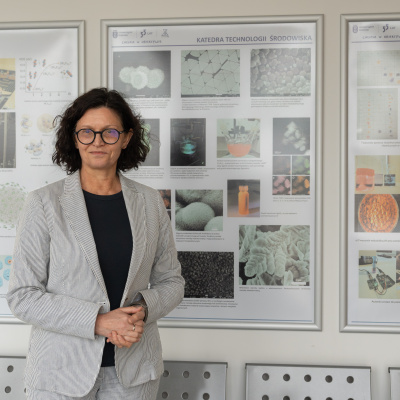
CKiP: - What is the purpose of capturing CO₂ from industrial gas streams?
Prof. Adriana Zaleska-Medynska: - CO2 is the main greenhouse gas generated by human activity, responsible for global warming. In 2024, global CO2 emissions reached a record high of 41.6 billion tonnes. Thus, the primary aim of capturing CO₂ from industrial gas streams is to reduce carbon dioxide emissions into the atmosphere, thereby mitigating the impact of industrial activity on climate change.
- What makes the CO2MAT project unique?
- One of the main technologies currently used for CO₂ separation is amine scrubbing, based on the reversible reaction of amines with carbon dioxide; however, this method has numerous limitations, including emissions of volatile compounds, solvent losses, high energy consumption, large plant sizes, etc. The advantage of the proposed solution lies in the use of a solid-state sorbent based on metal-organic frameworks ( MOFs), which will be derived from waste PET (a polymer used, amongst other things, in the production of bottles and packaging).
The advantages of the proposed sorbent include its higher CO₂ sorption capacity compared to commonly used amine solutions, its ease of regeneration, and the ability to precisely design MOFs: for example, by introducing specific ions, the MOF can be tailored to selectively capture carbon dioxide even in the presence of other gases.
- What challenges do you anticipate during the course of the project?
- The project is multi-stage and involves achieving specific milestones, including a sorbent material with a precisely specified sorption capacity, as well as a significant reduction in the costs of MOF synthesis, obtaining the sorbent in a form ready for industrial use (i.e. granules), as well as testing the resulting material in a pilot CO2 sorption plant, which needs to be designed and built. Consequently, we expect to face challenges at every stage of the research and development work. At the same time, my team already has experience in carrying out R&D projects where strictly defined objectives must be met.
- Would you like to share your thoughts on receiving the funding?
- It’s a real scientific rush. The whole team was very committed to preparing the project, including organising and taking part in a panel with experts from NCBiR and ORLEN, so we are absolutely delighted that the project has been recommended for funding. Research into new methods of MOF synthesis and new applications for MOFs is advancing very rapidly worldwide, and last year’s Nobel Prize for the development of metal-organic frameworks has further accelerated this work. Carrying out this project will allow us to make our own contribution to the advancement of MOF science.