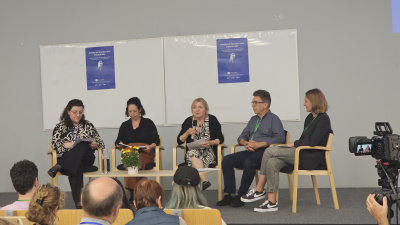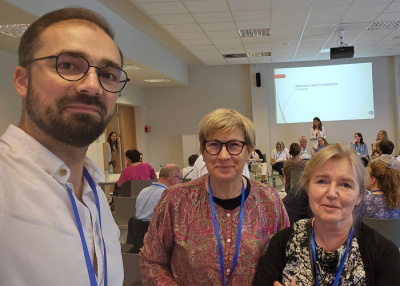
How can we build a city that responds to conflict not only with sanctions, but also through dialogue, accountability and the restoration of relationships? Representatives from the Faculty of Law and Administration at the University of Gdańsk, the University Arbitration and Mediation Centre, and the City of Gdańsk spoke about Gdańsk’s experiences in this area during the 13th International Conference of the European Forum for Restorative Justice, ‘Echoes of Restorative Encounters’, in Poznań.
The conference was attended by nearly 350 participants from around the world. Among them were academics, mediators, restorative justice practitioners, representatives of public institutions and non-governmental organisations, as well as individuals involved in developing alternative ways of responding to harm, conflict and breaches of social norms.
The European Forum for Restorative Justice is one of the most important international organisations operating in this field. It brings together practitioners, researchers and decision-makers, supports the development of mediation and other restorative practices, and creates a space for the exchange of experiences between individuals and institutions from different countries.
Gdańsk was represented by: dr Beata Czarnecka-Działuk, Katarzyna Stryjek and dr Jacek Wałdoch. Together, they gave a presentation showcasing Gdańsk as a city of restorative justice – a city that builds its identity around freedom, solidarity, dialogue, human rights and responsibility towards the community.
The presentation highlighted Gdańsk’s experiences with mediation and restorative practices. Particular attention was paid to school and peer mediation, including the work of the Gdańsk Centre for School and Peer Mediation, mediation-focused classes, mini-mediation sessions in nurseries, and work with young people requiring educational and social support.
The speakers highlighted that Gdańsk’s strength lies in its network of cooperation. The Gdańsk model is developing thanks to the involvement of the city, schools, psychological and pedagogical counselling centres, mediators, social organisations and the academic community. The University Arbitration and Mediation Centre at the University of Gdańsk also plays an important role, combining academic knowledge with mediation practice and legal education.
Gdańsk is not starting from scratch. There are already solutions in place that demonstrate that restorative practices can be integrated into the everyday lives of schools, families, local communities, and public institutions. It is not merely a matter of responding to serious conflicts, but of fostering a culture of dialogue in which the following questions are key: who has been wronged, what needs to be put right, and how can trust be rebuilt.
The participation of the Gdańsk delegation at the conference in Poznań provided an opportunity to showcase these experiences to the international restorative justice community. It also served as confirmation that Gdańsk has its own distinct path of development, based on education, mediation, human rights, solidarity, and inter-institutional cooperation.