
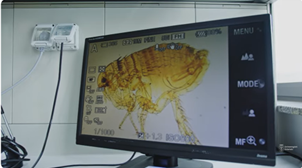
How can we talk about the parasites we encounter every day in a substantive and accessible way? The answer can be found in a series of popular and educational films produced by the staff of the Department of Invertebrate Zoology and Parasitology at the Faculty of Biology, University of Gdańsk.
The project entitled ‘Close, too close: ectoparasites around us’ consists of five popular science and educational films devoted to ectoparasites found in humans and companion animals.
‘We decided to prepare a series of videos because, in our teaching practice and contacts with the public, we have observed a clear deficit of reliable and consistent knowledge about ectoparasites. Although many people have general information about organisms such as ticks, fleas and lice, this usually does not include their mechanisms of functioning, biology, life cycles or effective methods of prevention. Meanwhile, this knowledge is of direct relevance to health. The aim of the videos was therefore to present the content in an accessible way, without alarmist elements, allowing viewers to obtain practical and useful information,’ explains dr Karolina Cierocka.
The selection of topics was based on an analysis of the ectoparasites most commonly found in the human environment and those species that cause significant health, sanitary or social problems.
‘We focused on the organisms that humans and companion animals come into contact with most often, such as ticks, fleas, lice, mites and demodex mites. Many myths and misconceptions have arisen around these groups, which further justified the need to prepare explanatory materials. Our intention was to present the current state of knowledge, organise key information and show its practical application in everyday situations,’ adds dr Paulina Kozina.
The materials explain the basics of parasitism, present the most important groups of ectoparasites of medical and veterinary importance, and teach how to recognise potential threats. The aim of the series is to raise awareness of prevention, early identification and safe behaviour in case of contact with parasites.
There is also a link to a survey under each video. ‘Please also fill in the surveys available in the video descriptions. This will allow us to evaluate the effectiveness of the video and help us create educational materials. It is anonymous and takes less than 2 minutes,’ adds dr Paulina Kozina.
The series includes the following episodes:
Episode 1: ‘Parasites - living at someone else's expense’
Watch the film: https://www.youtube.com/watch?v=RY6Rx3wWLPk
Fill out a short survey: https://forms.office.com/e/wviPpZzLAW
Episode 2: ‘Ticks - lurking vampires’
Watch the film: https://www.youtube.com/watch?v=E5Tm_T0N7gs
Complete a short survey: https://forms.office.com/e/dcsQw7gwXw
Episode 3: ‘Fleas - jumping nuisances’
Watch the film: https://www.youtube.com/watch?v=kUo0VBJ9TPo
Complete a short survey: https://forms.office.com/e/bZUC9rqLD8
Episode 4: ‘Lice - uninvited guests’
Watch the film: https://www.youtube.com/watch?v=uq2MZRm5V90
Complete a short survey: https://forms.office.com/e/yz8YiCAEVz
Episode 5: ‘The Microcosm in Our Skin’
Watch the film: https://www.youtube.com/watch?v=GeHHUTtyQQk
Complete a short survey: https://forms.office.com/e/wFnHhTx5p1
All episodes are available on the University of Gdańsk YouTube channel.
Film production Sebastian Jętczak/Centre for Event Organisation and Media Production, University of Gdańsk