
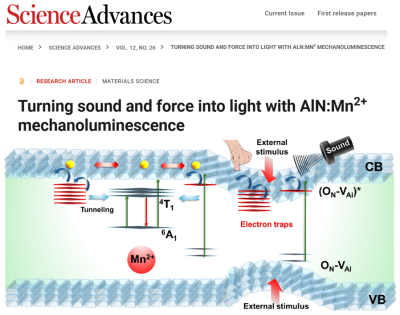
Can sound be converted into light? An international research team, led by scientists from the University of Gdańsk, has demonstrated that ultrasonic waves can trigger light emission in a luminescent material.
The research was led by scientists from the University of Gdańsk: dr hab. Sebastian Mahlik, prof. UG and dr Justyna Barzowska from the Institute of Experimental Physics. The project was carried out in collaboration with partners from Poland, China, Belgium, and the United States.
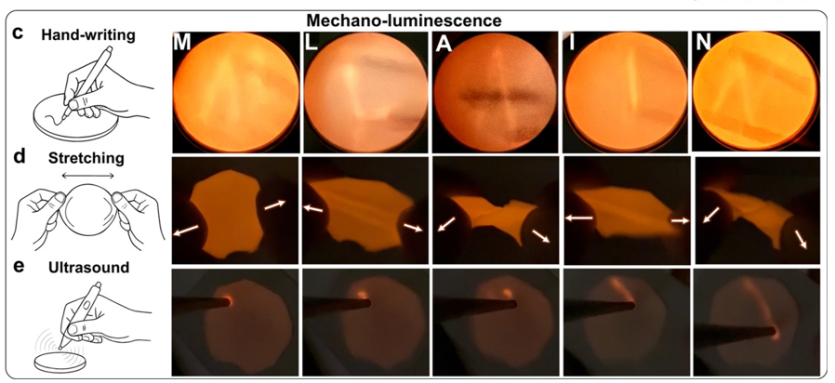
The team carried out comprehensive studies of the luminescent properties of manganese-ion-activated aluminium nitride (AlN:Mn). It was demonstrated that this material combines intense photoluminescence with long-afterglow luminescence, thermoluminescence (i.e. light emission induced by temperature) and mechanoluminescence (i.e. light emission triggered by mechanical forces). The most significant achievement was demonstrating that the material also emits light when exposed to ultrasonic waves and elucidating the mechanism behind this phenomenon. This discovery opens up new possibilities for using sound to stimulate light emission without physical contact, as well as for the development of innovative imaging and detection methods.
The research also showed that the material enables the conversion of mechanical energy, including ultrasonic waves, and thermal energy into light, whilst maintaining high chemical, mechanical and thermal stability. The authors have further demonstrated the possibility of integrating AlN:Mn2+ with flexible polymer composites, which allow the visualisation of friction, stretching and the effects of ultrasound. Such solutions could form the basis for a new generation of smart materials that respond to external stimuli.
‘The results obtained point to the material’s broad potential for applications in biomedical diagnostics, infrastructure and structural condition monitoring, next-generation optoelectronics, anti-counterfeiting systems, and remote imaging and detection technologies,’ says prof. Sebastian Mahlik.
The research involved scientists from the University of Gdańsk, Adam Mickiewicz University in Poznań, the Institute of Physics of the Polish Academy of Sciences, Hangzhou City University, Ghent University, Lawrence Livermore National Laboratory, Shenzhen University and the University of North Dakota.
The article was published in ‘Science Advances’, one of the world’s most prestigious scientific journals, which is part of the Science family.
Publication:
Justyna Barzowska, Syed Shabhi Haider, Teng Zheng, Andrzej Suchocki, Philippe F. Smet, Marcin Runowski, Nerine J. Cherepy, Dengfeng Peng, Sebastian Mahlik, Turning sound and force into light with AlN:Mn2+ mechanoluminescence, Science Advances 12 (2026), eaed5469.